The name of this post should really be, “I got dry needled and lived to tell about it.”

One of our teachers, Kari, is a physical therapist and has been doing quite a bit of dry needling at the clinic she manages lately. She has been encouraging me to try it for months now so when she offered to work on my calf after the half marathon, I finally agreed. More on that in a moment. First, let’s talk about calf muscles and my background with calf strain.

If there is one thing that’s going to bother me after long runs or races, it’s my calf muscles and especially my left one. The spot around where my achilles and calf attach tends to get really sore. If you look at this diagram of the anatomy of the calf, it’s mostly around my soleus. I struggled with achilles tendonitis back when I was training for my very first marathon years ago. My achilles tendonitis was mostly due to tightness in my feet and lack of flexion in my big toes but since I’ve increased that greatly through yoga, it’s improved a lot.
Even still, I have to be super careful with my calf muscles not to strain them. When I hosted my online half marathon training group last fall, I was surprised by how many others experienced similar pain. I thought it would be helpful to share some ways that I have learned to deal calf strain and also prevent it.
- Slowly increase mileage. When I’m in training mode, I find that I can stay ahead of calf strain if I slowly increase my mileage and don’t make any sudden jumps in long run distance.
- Wear compression socks or tape up the calf/achilles with KT tape. This has been a huge help for me and you’ll never find me tackling a long run without compression or taping.
- Take two days off after long runs. This is different for everyone but I have learned that I need two full days off from running after long runs to recover enough to make a big impact on injury prevention. Even when I wake up feeling totally fine the next day, I force myself to take time off.
- Stretch it out. As I mentioned above, a regular yoga practice has been a huge benefit for my body in preventing running injuries of all types, including calf strain/achilles tendonitis. Isn’t it the craziest thing that tightness in your big toes can result in achilles tendonitis and calf strain? Our bodies are so interconnected. Check out this video for a tutorial on how to roll out your feet.
- Warm up properly, especially when doing speed work or racing short distances. All out effort without a proper warm up is a recipe for disaster when it comes to my calf muscles. I always make sure to do dynamic stretching and run an easy mile or so before starting any sprint/speed work or before short races like 5Ks where I’ll be giving all out effort from the start. Last August I raced a 5K and arrived too late to get my full warm up in. I paid for that mistake for two weeks after when I couldn’t run due to calf strain.
- STOP at the first sign of pain. My calf pain is very, very specific so there is no denying it when I start to feel it. I’ve learned that continuing to run on it only exacerbates the issue and that if I stop, rest it and treat it that I can reduce the amount of time that I’m down with it. For me this usually means 7-10 days off of running along with a lot of work on my own and with professionals to treat it while it’s acute. I do things like calf raises to move it through a range of movement, muscle flossing with resistance bands, ice, massage, active release therapy, scraping, etc. Dr. Bradberry and the team at Greenapple has been a huge help with this.
It really comes down to not doing too much too fast. It’s sounds so simple and it is. The problem is that sometimes we forget all of the lessons we’ve learned in the past about it and think we’re invincible super runners. Then reality comes in like a wrecking ball. 🙂
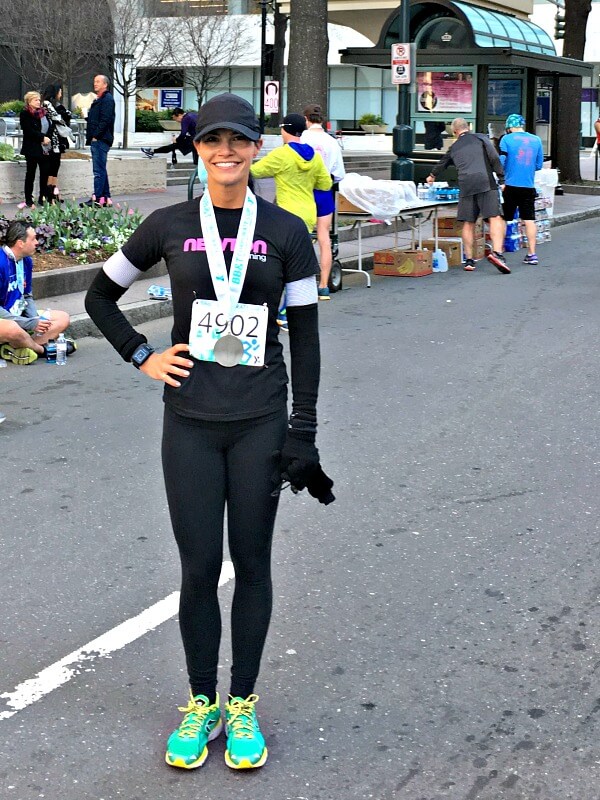
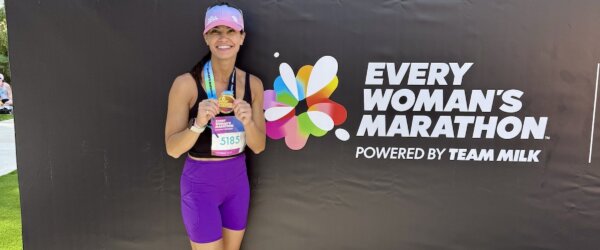
Fast forward to a couple of weeks ago…I was shocked by how good I felt after my unplanned half marathon. I had minimal soreness. I took my two full days off of running after the half and then did a short and easy three-mile treadmill run the following Tuesday. While there was no calf pain, I could definitely “feel it.” I ran again on Thursday with Virginia and I could still feel it. It never crossed the threshold into pain but I knew I needed to do something before it did.

Enter the dry needling with Kari. She promised that it would help loosen up my calf and that it would only take 15 minutes. Kari showed up at the studio later that afternoon with the needles and when she instructed me to lay down in the middle of our office floor I was like, “okay…this is happening.” My marketing coordinator documented the experience with photos and asked me wide-eyed, “have you seen the size of the needles she’s using?” I was just trying to stay focused on my yoga breathing and could not watch Kari while she was needling.

Let’s talk about dry needling and what it does. According to the American Physical Therapy Association…
“Dry needling is a skilled intervention that uses a thin filiform needle to penetrate the skin and stimulate underlying myofascial trigger points, muscular, and connective tissues for the management of neuromusculoskeletal pain and movement impairments. [It] is a technique used to treat dysfunctions in skeletal muscle, fascia, and connective tissue, and to diminish persistent peripheral nociceptive input, and reduce or restore impairments in body structure and function, leading to improved activity and participation.”

Kari worked to find trigger points in my calf muscles and then inserted needles into them This works to create relaxation through disruption as well as in creating tiny injuries that promote a healing response to restore normal function. She needled my soleus, gastrocnemius and peroneus. I wish I could tell you that it didn’t hurt that bad but HOLY CRAP, it was so painful. Kari told me that the calf is one of the most tender places to needle, which makes sense. The best way to describe it was as a deep/burning muscle pain but it was over quickly.
I was instructed to drink a lot of water and move around to help with soreness. Kari warned me that my calf would feel pretty sore for about 24 hours after but then I should feel noticeable improvement. She was right, I was extremely sore immediately after the treatment. I sat at my desk for an hour and then got up to walk around and was hobbling. I chugged some water and went home and took the dogs for a walk and that helped so much. I felt pretty okay after that.
And five days later I can report that my calf feels 100% good and normal so I definitely think that the dry needling treatment benefited me post-race. Now whether or not I’ll make it a regular thing like Kari suggested remains to be seen. 😉
Have you ever experienced calf strain or achilles tendonitis? If yes, how did you treat it and how do you prevent it?
Have you ever tried dry needling?